

Emotional Marketing vs. Rational Marketing
Emotional Marketing vs. Rational Marketing: What Tech-Savvy Businesses Need to Know
In the highly competitive world of today, companies, particularly those in the field of technology, often have to make a crucial decision about whether their marketing should speak to the heart or to the head. But what really happens is that the best marketing strategies strike a perfect balance between the two approaches to create marketing messages that are convincing yet profound at the same time. For customers who appreciate innovation and proof equally well, this is something that must be taken into account. Here is where Nexotechsoft comes into play as your marketing partner.
Understanding Emotional Marketing
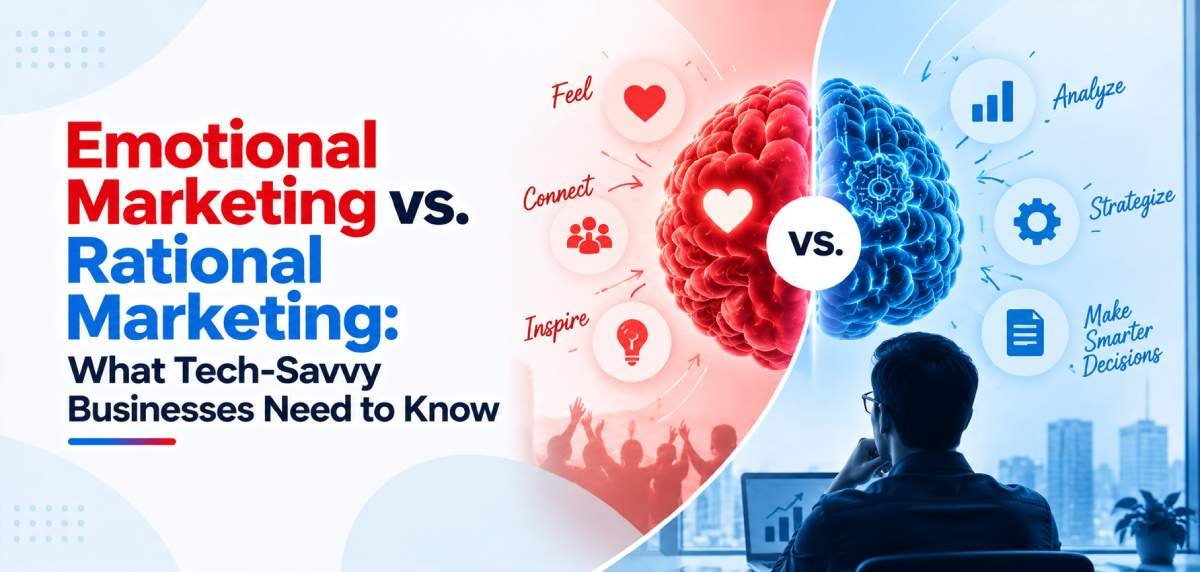
Emotional marketing connects brands to their target audience by leveraging feelings, values, and hopes. Instead of concentrating on specifications or product features, emotional marketing creates an appealing story that can evoke trust, excitement, relief, or pride. In the case of technology companies, this could involve communicating about how much easier life becomes for IT professionals when implementing a certain solution or about how much more creative developers become working with a specific product.
Studies have proven that emotional marketing produces better results when it comes to brand effects over time. Even in B2B contexts, emotional messages tend to be seven times more effective than rational ones in terms of their business outcomes. The reason for this is simple: despite the technical nature of their purchase decision, people remain emotional creatures. The same tech executive who calculates the ROI of cloud migrations would probably start doing that because of a wish not to have any downtime, prevent the burnout of his employees, or beat competitors.
Successful emotional marketing when targeting tech-savvy customers does not involve trickery or overstated information. On the contrary, such marketing should revolve around real stories and results. For example, instead of using the phrase “Our platform guarantees 99.99% uptime,” one can go with the message “Rest easy because our systems never rest.“ Such an approach wins attention and helps create brand loyalty, which rational communication is unable to create.
The Role of Rational Marketing
Rational marketing, on the other hand, relies on logic, facts, and advantages. In most cases, it features tangible facts, such as performance metrics, savings, certifications, integration, and compliance. With a technically savvy audience, such as engineers, chief technology officers, procurement officers, and decision-makers who make their choices based on numbers, these types of facts are not only important but often crucial.
Rational messages address the reasons why something needs to be purchased and how. They offer the information that helps to justify a choice made and secure buy-in from different people at the different stages of a complex B2B sales cycle. A SaaS company, for example, can talk about SOC 2 compliance, latency benchmarks, and total cost of ownership in order to persuade its clients that the product is both great and defensible.
Whereas emotional marketing generates interest and initiates action, rational marketing eliminates friction and makes the final decision easy. It engages the prefrontal cortex, which is responsible for analytical thinking and offers all those reasons that help prospects make up their minds. Without a rational message, an emotionally appealing story will lose its power at the procurement and audit stage.
Why Tech Businesses Need Both
The myth of the purely rational B2B buyer has been thoroughly debunked. Data from Gartner, Forrester, and the CEB shows that emotion drives business buying just as much as it does consumer purchases. However, that doesn’t mean logic is irrelevant. In fact, the most successful technology marketing strategies recognise that emotion and
reason serve different—but complementary—roles in the buyer’s journey.
Emotional persuasion is especially strong for branding efforts. This kind of message will reach a wide audience, including people who are not yet in the market for products, and condition them to associate your brand with their needs in the future. Conversely, rational persuasion is very effective at driving sales activation through the provision of relevant information to an existing customer base.
This would mean that for technology firms, top-of-funnel marketing efforts like videos, thought leadership pieces, and social media campaigns should be predominantly emotional in order to get the customers’ attention and create an affinity towards your brand. Meanwhile, middle- and bottom-of-funnel efforts like case studies, technical white papers, or product demos should contain elements of rational persuasion.
Common Pitfalls to Avoid
The most typical blunder made by many technology marketers is overusing rational messages. Marketers believe that all consumers are interested only in features, benchmarking, and ROI models. However, although these elements are essential in marketing messages, when leading with them, marketers create unmemorable and dry content that does not help them stand out from other companies.
On the contrary, there are also marketing companies that go too far with emotions and do not give any actual value to customers. In this case, technology buyers see campaigns as pure emotional blabber and unreliable hype. The right marketing tactic is to combine both of these elements.
The third mistake, which is typical for many technology marketers, is using an inappropriate appeal. The problem is that emotions are great for campaigns that are aimed at attracting the attention of many people. However, in this case, such messages will not work with high-intent search traffic. Rational messages are great for product pages but not for social media.
How nexotechsoft Helps Businesses Master Both Approaches
Here is where the skills of nexotechsoft come into play. As a provider of professional services, Nexotechsoft does not provide any products. On the contrary, it helps firms create, implement, and fine-tune their marketing campaigns, balancing the use of emotions and rationality properly.
The services provided by Nexotechsoft include positioning, architecture of content, campaign planning and performance analysis. The professionals at Nexotechsoft assist clients in determining what the most significant emotional motivators are for the targeted audience, such as minimisation of risks, innovation opportunities, and reduction of complexity, and complement them with corresponding proof points. This may include customer transformation stories, refinement of the value proposition, or creation of content architecture that will lead prospects from being aware of the problem to making a final decision.
It should be noted that the company has a solid understanding of the technology market, where customers are highly sceptical of hype and expect proof of the claims. At the same time, even the most technical customers can be motivated by the story that speaks about their pain and desires. Thus, Nexotechsoft allows building memorable and credible brands.
Practical Steps to Integrate Emotional and Rational Marketing
Firms that wish to enhance their marketing mix should begin with an audit of what they already have. Is the content at the top of the funnel too technical? Is there no emotional story around their products on the website? Knowing where you stand is crucial for balancing your content mix.
The next thing is creating the map of the buyer journey and figuring out the correct appeal for every step. Begin with emotional stories and then use the logical part of your message when your prospects are ready for decision-making. Try different combinations through A/B testing.
The final step is choosing a partner who knows how to balance these two worlds. Technology agencies or consultants could be very helpful here.
Conclusion
It is essential to realise that there is no contradiction between emotional marketing and rational marketing. Instead, these approaches should complement each other, which makes it possible to increase brand development and sales results simultaneously. Businesses should be careful when implementing different strategies since the purpose of the approach is to engage customers, provide them with relevant information, and convert leads into clients.
The use of these approaches by companies creates a huge competitive advantage for the company because such organisations develop strong brands and give customers all the necessary information. All businesses that use the right strategy, especially when working with the right partner such as Nexotechsoft, are capable of increasing brand development and sales results significantly.