


AI Mistakes That Hurt Your Brand
AI Mistakes That Hurt Your Brand
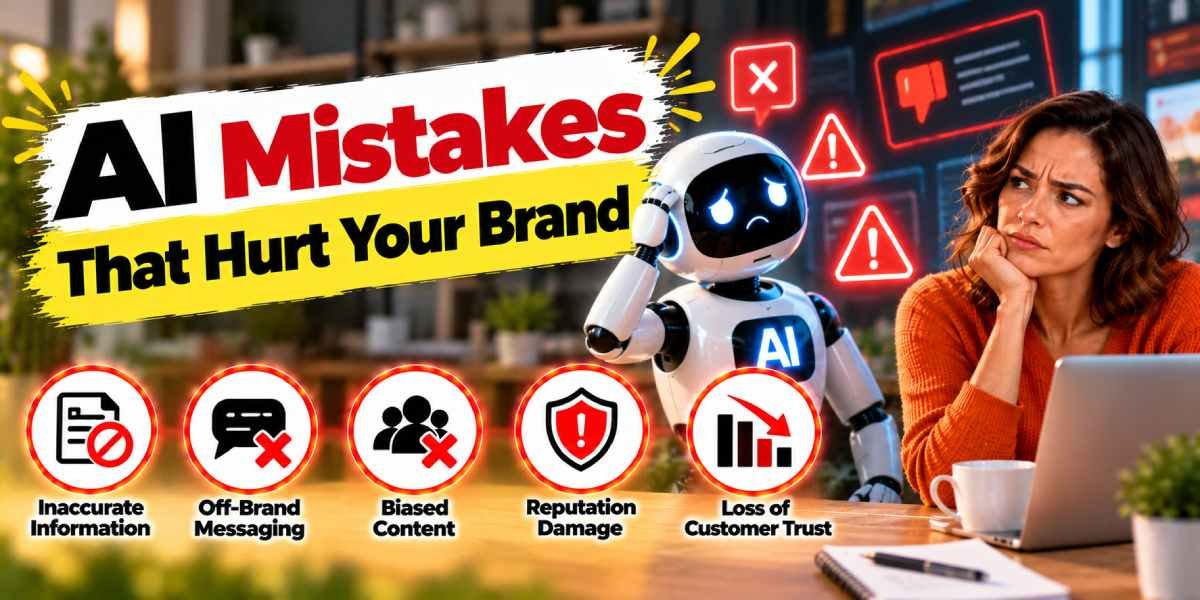
Artificial intelligence has the ability to help brands be faster, more intelligent, and agile; but AI could also give a bad impression of carelessness, generality, or even a lack of trustworthiness. The largest AI mishaps do not occur due to the technology itself. They are caused by the organisations’ failure to incorporate AI into their processes and systems strategically, with quality and governance controls, and with sound judgment. Without these considerations, organisations may harm their reputation, which took decades to build up, through the careless use of AI.
The use of artificial intelligence has become standard practice for marketing, customer service, content generation, sales, and operations functions today. However, the risk is still significant. AI may lead to inaccuracies and biases in information generated; biased recommendations; off-brand messaging; and privacy issues. AI-related failures will negatively affect the reputation by diminishing credibility and customer experience. Therefore, organisations will not be successful in adopting AI through automation alone.
Treating AI as a Strategy
The most widespread mistake is the implementation of AI just because other companies implement it. Many organisations implement AI tools without defining the issue that needs to be addressed, who their clients are, and what benefits they expect to get from using the tool.
The first step towards the successful implementation of AI is considering customers’ journey. Businesses need to think not about how to implement AI into their work but about how it will benefit the customer experience and eliminate friction. It could be used to answer customers’ routine questions, to create various versions of marketing messages, to summarise support tickets, to qualify leads, to automate some back office tasks. However, it would be inappropriate to use AI for dealing with complaints, making decisions regarding products, giving legal advice, communicating in emotionally colored conversation.
Nexotechsoft helps organisations to adopt AI in a practical way. As a professional partner in technology and digital transformation, Nexotechsoft offers services in software development, website development, digital solutions, business automation, lead generation, and technology consulting.
Publishing Unverified AI Content
Generative AI can create polished articles, advertisements, emails, product descriptions, and social posts in seconds. The problem is that polished does not mean accurate. AI models can produce false statistics, invented references, incorrect product claims, and misleading statements with complete confidence. These errors are known as hallucinations, and they become especially damaging when published under a company’s name.
In most cases, the customer identifies the model with the brand. The issue with that is whenever a chatbot makes a promise of a return policy that does not exist or a landing page written through AI makes a promise on the product’s performance capabilities which cannot be validated, customers will perceive the company as being not credible. In the field of marketing, where credibility is everything, hallucinations pose legal and reputational risks.
Each and every output of the AI that is going to be released should go through a process of being validated by an authorised expert before the release of the content. In particular, the following should be reviewed and validated: pricing, specifications, medical/financial statements, legal language, customer commitments and technical content. Additionally, authorised sources should be used in creating AI outputs.
Letting AI Dilute Your Brand Voice
AI excels at generating text that seems reasonable, but “reasonable” does not equate to unique. As companies use standard prompts and similar AI technologies without brand guidelines, the result will be sameness in the content generated. The headlines become meaningless; messaging becomes redundant, and the brand identity fades.
The voice of the brand is not only about tone of voice. It can be vocabulary, point of view, technicality, empathy, sense of humour, cultural sensitivity, as well as business commitments, among others. When the AI is allowed to continue writing outside this framework, it will end up writing something that is readable but lacks life. Ultimately, it will destroy the differentiation and make the company just another company among those using the same AI technology.
The remedy to the issue is to establish a voice of the brand framework first and then allow the AI to write within the framework. The companies should define the tone of voice, audience personas, language, message restrictions, format, and great communication examples for the brand.
Ignoring Data Privacy and Security
AI may require access to customer data, internal communications, sales information, customer service chats, and product information. Unless there are proper safeguards, the data may be exposed through the use of prompts, third-party tools, logging, and improperly set up integrations. This is not only an issue of the technical kind, but it is a trust issue too.
Customers expect the business to take care of their data. A failure in the matter of privacy caused by an AI will harm the company much faster than a conventional data breach. It shows that the company has embraced powerful technologies without taking the necessary security measures. The technical measures that must be taken include AI gateways, data loss prevention, and limitations on unapproved tool usage.
Before implementing AI, businesses have to make a policy concerning what data may be used, how it may be accessed, how long it can be stored, and what tools will be allowed. Confidential customer data, product information that has not been released yet, source code, and all regulated information should never be inputted into any unapproved AI.
Automating Customer Experience Too Aggressively
Chatbots and virtual assistants powered by artificial intelligence could be helpful in reducing the time spent on answering and dealing with frequently asked questions. However, if organisations employ chatbots to completely avoid contact with people, the customers would certainly feel ignored. This especially concerns cases when there is a problem related to bills, emergencies, technical support or emotional issues.
The failure of a chatbot to correctly understand the context, to provide proper information or to connect to a human being leads to the frustration of customers. They are not interested in the reason for the error – whether it was a limitation of the algorithm or the inefficiency of the process management; they just have a bad experience.
The best customer experiences are those which are hybrid. The AI should take care of all the regular customer queries such as updating the status of the order, making an appointment, resetting the password, etc. Complaints, escalation, negotiations, and anything that involves risks should be taken care of by humans. The AI should make the transition to the human at the point where there is any confusion, frustration or risk involved, taking into account the entire conversation.
Using Biased or Unfair AI Models
AI learns from data, which is based on history. Bias exists in data, and it means that biased outputs of AI can result in discrimination in various fields such as hiring, pricing, lead scoring, targeting, recommendations, and customer segmentation. It brings about ethical, legal, and reputational risks.
The outputs of a biased system can lead to discrimination, which will negatively impact reputation and customers’ trust, especially in cases of discrimination against a protected group. For example, a biased recommendation system will constantly recommend some products or opportunities to some customers but not to others, regardless of whether there was any intention to do so.
Businesses need to test AI systems for different customer segments, analyse the outputs, and explain the way decisions are being made. Pre-deployment testing must include red teaming in order to detect outputs that can be harmful if released publicly. Filters must block generation of content that goes against the principles of an organisation.
Over-Personalizing Without Consent
Personalisation can improve relevance, but it can quickly become intrusive. AI can analyse browsing behaviour, purchase history, location, engagement patterns, and inferred preferences to deliver highly targeted messages. Used well, personalisation feels helpful. Used poorly, it feels like surveillance.
Consumers do not wish to have any of the inferences disclosed, any of the segmentation labels revealed, or any of the personal information leveraged against them to make a decision. While manipulative strategies like the ones mentioned above may help increase conversion in the short run, they will hurt the brand’s reputation in the long run. Personalisation done right should be predicated on an honest value proposition for the customer – they provide the information about their preferences because they get better recommendations and offers.
It will be wise for businesses to allow customers an opportunity to choose how their data is used and how they should be communicated with. The synthetic media generated by AI should also be considered. Companies can build trust reserves through being open about the use of AI and its limitations.
Failing to Measure AI Performance
Organisations tend to implement AI features without evaluating their efficiency in improving the organisation. Organisations focus on volume metrics, such as more blogs being created, more emails being sent out, and more chatbot interactions. This leads to a distorted view of improvement.
Artificial Intelligence should be treated as any other investment in the organisation and should be benchmarked against baseline metrics, such as time to response, lead quality, content consumption, rate of resolution, customer satisfaction rate, error rate, and impact on revenue. After deployment, the results should be analysed using those metrics to determine whether AI is doing well or not.
One more step that should be taken is conducting an audit of the AI system. Some changes may occur in the algorithm, customer behaviour, or data sources, which may have negative effects on the performance of the AI and cause some problems.
Building AI Without Human Accountability
One of the most common mistakes that one could make is to believe that AI removes the sense of responsibility from the equation. The company retains all responsibility if its AI system produces false statements, discriminates in the selection of targets, violates the confidentiality of customer information, and makes errors when interacting with customers.
It is important to assign owners to all AI processes. Marketing could become the owner of the brand voice, legal – of compliance, IT – of cybersecurity, data teams – of the quality of AI models, and the customer experience team – of the customer experience. It is crucial to distinguish between general-purpose AI and decision-making AI.
Accountability does not prevent innovation but provides the possibility of safe innovation. AI is supposed to complement human skills rather than replace the human skills and responsibility customers expect.
Conclusion
AI will not harm your brand since it is an effective technology. But then, your brand will suffer from AI when it is implemented without accuracy, branding, privacy settings, human control, or any specific reason at all. In essence, the best brands are those that successfully combine intelligent automation with good sense, transparency, and knowledge of their audience.
Don’t see AI as a way out.See it as a technological solution that mirrors your standards, your data, and your decisions. AI will enhance your brand if it is governed, designed, and professionally implemented. Nexotechsoft offers professional services for businesses in terms of software development, digitalisation, automation, lead generation, and technology consultation.