


The Biggest Marketing Mistakes CEOs Make
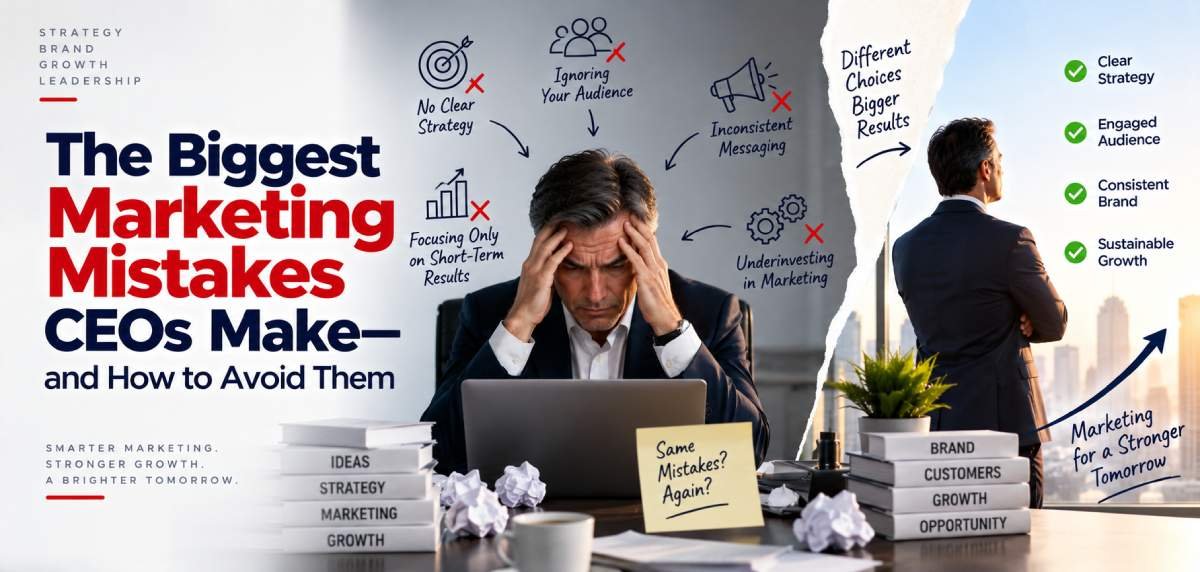
The Biggest Marketing Mistakes CEOs Make—and How to Avoid Them
Marketing does not consist only of advertising, social media, and other campaigns. For technology businesses nowadays, marketing impacts strategy, customer experience, product positioning, sales and even growth.
On the contrary, there are many CEOs who see marketing as a combination of different activities without a bigger perspective and strategy. They spend on a new website without having their market positioning defined, start advertising without knowing their target customers or measure success based on website visits, not the number of qualified leads and revenue.
All these actions can lead to many activities without real business results. The costliest marketing blunders are often made at the highest managerial levels. They are made due to lack of prioritisation, weak customer research, lack of alignment of messages, lack of integration between sales and marketing and the inability to measure marketing spend against business goals.
Strategic decision-making is key for technology firms in competitive and dynamic environments. The buyers know a lot about the product; the purchase process involves several people, and trust is crucial when selecting the service provider.
This article explores the biggest marketing mistakes CEOs make and explains how to avoid them. It also highlights how Nexotechsoft supports organisations through professional technology services and expertise. Nexotechsoft does not sell tools or software products. Instead, the company provides professional services tailored to the specific needs and objectives of its clients.
Treating Marketing as an Afterthought
A classic example of what not to do is introducing marketing into the decision-making process too late.
In some companies, it happens that marketing is introduced when the product development has already been finished, the price is set, and the business executives have already decided on the identity of their customers. This way, the company expects the marketing department to create a demand for a product of undefined positioning.
This approach creates unnecessary challenges. Marketing can learn that the product will not help solve any urgent need, that the message cannot be easily conveyed, or that competitors have already established themselves in that market positioning area.
Marketing involvement should take place before final decisions are made. Market research can enable leadership to know what their customers want, how much competition there is, what price expectations there are, and what potential for growth exists. Market research can also show whether the proposed product will be relevant to a definite market segment.
A CEO doesn’t necessarily have to let marketing control all the business decisions. Nonetheless, marketing input should come into play when discussing product development, target markets, pricing strategies, branding, and growth plans. When marketing comes in early, marketing becomes a strategic resource, not just the promotion department.
Trying to Target Everyone
CEOs usually think that a broad target market will give more opportunities. On the contrary, a broad target means being irrelevant to everybody.
Tech companies often have vague statements like “we help businesses transform digitally” or “we offer innovative solutions for companies of different industries”. Such statements may be impressive; however, they say nothing about the type of companies served, problems addressed or reasons why people should work with them.
To solve this problem, it is necessary to create a description of the ideal customer. The definition of an ideal customer should be broader than industry or company size and should contain more information about the customer’s business challenges, purchasing process, environment, budget, objectives and criteria.
Instead of targeting all companies interested in tech services, the business could address growing companies that require modernisation of their old-fashioned systems but lack the required resources internally. Such an approach will allow developing a strong base for the website, sales talks, case studies and digital marketing.
This approach does not mean that it will restrict growth opportunities. On the contrary, such market position will increase growth effectiveness.
CEOs should regularly ask which customer groups produce the strongest results, receive the greatest value, and are most likely to become long-term partners. These answers can guide marketing investment more effectively than a broad ambition to serve everyone.
Confusing Founder Belief with Customer Demand
Founders and CEOs often have strong beliefs about their products, services, and markets. This confidence is important, especially during the early stages of a business. However, personal conviction should not replace customer evidence.
In this case, what the leadership of the company thinks its customers value can be very different from what the customers themselves are actually concerned about. Leadership might pay attention to some technical innovations, while customers could be more interested in speed of execution, costs, reliability, safety, and other aspects of the offering.
The best way to find out about this gap between the perceptions is to simply talk to customers and potential customers. Interviews, post-call debriefing of sales conversations, customer surveys, support conversations, win/loss analysis, and customer usage data can all help you understand how the market really sees things.
Good customer research is always behavioural and strategic. Do not ask customers how much they like your ideas. Ask them what the problem is that they are trying to address, what alternative options they consider, why they do not act on it now, and what consequences their problem has for their business.
It does not mean that you should discard the founder’s vision. You need to validate and refine it.
Focusing on Features Instead of Outcomes
Technology companies often describe themselves through features, platforms, frameworks, integrations, and technical capabilities. These details may demonstrate expertise, but they do not always explain why the customer should care.
Most buyers are ultimately interested in outcomes. They want to reduce costs, improve productivity, increase operational visibility, strengthen security, accelerate delivery, or create a better experience for their customers.
Compare these two statements:
“We provide scalable application development using modern technologies.”
“We help growing companies modernise their applications so they can improve performance, reduce maintenance challenges, and deliver updates faster.”
The first statement describes a capability. The second connects that capability to
business value.
Technical details should not be removed from marketing. Technical buyers often want to understand architecture, development processes, security standards, and implementation methods. The difference is that technical information should be presented in context.
The CEO must evaluate the company’s website, presentation, proposal, and campaign to ensure that it conveys the business value of what is being done technically. If a customer cannot easily understand why the service will enhance his or her experience, the messaging may be too feature-driven.
Choosing Channels Before Defining the Strategy
Another common mistake is selecting marketing channels before deciding what the company wants to accomplish.
A CEO may ask the team to start a social media campaign, invest in search advertising, create a podcast, or publish daily content simply because competitors are doing it. However, channels are not strategies. They are methods for reaching an audience.
This will depend upon the target customer, the purchase process, the sales process, the nature of the product/service, and the kind of information that the customer needs in order to make his/her decision.
For example, an expensive B2B technology solution might call for white papers, case studies, search presence, referrals, consultative advice, and sales contacts. Customers might need multiple interactions before they feel comfortable enough with the vendor to start the dialogue.
Only after the company has established its audience, problem, message, action, and measurements can it move on to decide how to communicate.
This approach prevents wasted budget and reduces the temptation to maintain a presence on every platform without a clear purpose.
Measuring Activity Instead of Business Impact
Typically, marketing analytics include such statistics as impressions, clicks, followers, content downloads, website visits, and emails opened. These are helpful factors, but their presence does not mean that marketing brings profits to the business automatically.
Many people visiting a website do not necessarily belong to the target audience. Large numbers of content downloads are good, yet they can bring no profit if they do not lead to a conversation. Engagement on social networks can bring more visibility, but visibility itself does not bring any profit.
CEOs must find a link between the measurement of marketing activities and the aims of the business. Depending on the aims of the business, this can be about the number of qualified opportunities, the value of the pipeline, customer acquisition costs, conversions, sales cycle, customer retention, expansion revenue, and ROI from marketing.
Not all marketing activities will bring immediate revenues. Brand building, education, and visibility in searches can affect the decision-making process of potential clients for a long time. Yet CEOs must realize which activities play which role in the customer’s journey.
A strong marketing review should focus on decisions rather than numbers alone. The team should discuss what the data reveals, which assumptions have changed, what customers are responding to, and where investment should increase or decrease.
Expecting Immediate Results from Every Initiative
Marketing performance does not develop at the same speed across every activity.
Some campaigns may produce leads within days. Other activities like SEO, thought leadership, customer advocacy, and branding may take time to bear their full fruit due to persistent execution.
One mistake that a CEO can make is dropping an activity or a plan too soon because it hasn’t shown any results. A firm may start a content marketing program, post some blog entries, receive little traffic, and conclude that content marketing doesn’t work for it. However, this conclusion could be a wrong one based on the following factors.
This does not mean leadership should continue funding ineffective activities indefinitely. It means marketing should be evaluated using realistic timeframes and appropriate indicators.
Early-stage measures might include relevant engagement, search visibility, content consumption, or sales feedback. Later measures may include qualified inquiries, assisted conversions, opportunities, and revenue contribution.
Strategic patience is not the same as ignoring performance. It means evaluating performance according to the maturity and purpose of the initiative.
Keeping Sales and Marketing in Silos
However, despite having common objectives, sales and marketing have different priorities. The former might prioritise lead generation and visibility, while the latter might focus on opportunity closure. Without alignment, both sides risk getting frustrated.
Marketing might think that it creates enough leads, but sales will consider that leads are not qualified enough. Sales might ask for more appropriate content creation, while marketing does not get much information from prospects’ inquiries and objections.
CEOs play an important part in bringing both parties to agreement. Sales and marketing should understand each other about the target customer, the standard of qualifications, positioning, revenue targets, and the buyer’s journey.
Sales can help marketing to understand customers’ objections and concerns, which allows marketing to create better content, campaigns, case studies, and positioning.
This alignment is particularly important for professional services companies, where expertise, trust, communication, and perceived fit often influence the purchase decision.
Underinvesting in Brand and Trust
Some CEOs view branding as a cosmetic exercise. They focus on lead generation and sales activity while treating brand clarity and credibility as secondary concerns.
Buyers usually investigate the company prior to making contact in technological markets. They may look at the website, read about cases, articles, comparisons of services offered, and check for any sign of experience.
The importance of a good brand in helping clients to understand what the firm offers, whom it serves, its uniqueness and why it should be trusted cannot be underestimated.
For Nexotechsoft, proper positioning is highly crucial due to the nature of the services that the company provides. The branding must highlight experience, flexibility, technical knowledge, and ability to solve problems that the client faces.
Nexotechsoft does not sell tools or software products. It provides professional services that help organisations address technology and business needs through practical expertise and tailored support.
Conclusion
The most common mistakes that CEOs make in marketing have nothing to do with lack of creativity. They result from poor strategic decision-making.
Addressing all markets at once, assuming things internally, concentrating on features, channel selection without strategy, activity metrics instead of results, and frequent change of course may all restrain growth. In technology industries, such issues become even more expensive because buyers require expertise, transparency, credibility, and value.
There is much that CEOs can do to improve the performance of marketing: involve marketing early in the process, listen carefully to their clients, define an effective market positioning, align sales and marketing efforts, invest in trust, and measure results for business growth.
Nexotechsoft offers expertise in technology and professional services based on specific customer requirements. It does not provide tools and software products. It helps its clients solve technology and business challenges using its expertise delivered as a service.
In case CEOs use customer insight, positioning, implementation, and measurement of results, marketing will be far beyond just promotion. It will be a strategic process, enabling better decisions and relationships and supporting business growth.