

Scaling Without Increasing Your Ad Budget
Scaling Without Increasing Your Ad Budget
Any growing company will face the same situation eventually: things are getting better, demand is increasing, but the budget for advertising cannot go on increasing forever. The good thing about scaling is that it is not a matter of budget – it is a matter of efficiency. The better your funnel works, the more efficient your creative is, the more intelligent your audience targeting is, the more value your existing clients bring – the more revenue you generate without spending extra money on ads.
And here comes the point where most companies stop growing. They see paid media as a tap: increase the budget, get more leads, and freak out when the cost of acquisition goes up. The right way would be to treat advertising as just one of the elements of a growth system. This is what we do at Nexotechsoft.
Why More Budget Often Creates More Waste
Increased spending on advertisements could appear as the simplest method to expand, but this normally reveals weaknesses that were there even in a lower budget. A successful advertising campaign at a lower budget would no longer be successful after its scale has been increased to reach larger audiences, less appropriate placements, or more impressions. The CPC will rise, conversion rate will fall, and creatives will become outdated.
This happens because the budget only amplifies what is already there. When you have an unclear offer, a slow landing page, inconsistent follow-up, and missing tracking, spending more budget does nothing except increase those problems. Performance marketers usually track metrics like return on ad spend, cost per acquisition, conversion rate, and customer lifetime value since scaling should be based on profitability and not just impressions or clicks.
The right question before spending more budget is how much more revenue the existing system can generate without additional spending. In most cases, the answer is more than people think.
Start With a Full-Funnel Audit
Scaling without further budget starts with visibility. One cannot optimise something if one cannot measure it accurately. A full-funnel audit analyses all stages starting from the very first impression of the ad and ending with the purchase and even later.
Pay attention to how users go through the funnel. Do people click the ad but leave the site right after visiting the landing page? Do people add goods to the cart but don’t continue the purchase process? Do leads fill in the form but get no response? These are all opportunities for earning money that you have now with your current traffic.
A real audit should link advertising statistics to website statistics, CRM stats, sales results, and user retention. This is important since the conversion rates stated by platforms often do not correspond to reality. Linking the campaign results to the actual revenue will help you understand which channels, audience, creatives, and offers work well.
Nexotechsoft assists companies in creating such a measurement system using professional digital marketing strategy, analytics implementation, conversion optimisation, and performance review.
Improve Conversion Rate Before Chasing Traffic
The most effective way of scaling without increasing spending is to improve conversion rate. If your website converts 2 per cent of people who visit it into leads or customers, then doubling the conversion rate to 4 per cent will help you to double production using the same traffic.
Small improvements mean big results. Even small improvements in any of the elements such as headlines, call to action, speed, form usability, mobile usability, or credibility can mean the world of difference. The landing page has to correspond with the promises made in the ad and not completely contradict them. Once you get your messaging right on both the pages, your visitor is all set to take the next step.
Conversion rate optimisation is an ongoing process rather than a one-time redesign process. Test a variable at a time – offer, main headline, length of form, placement of social proof, or call to action. Don’t test minor things such as the colour of the button until you solve major problems.
For example, an e-commerce business may discover that most mobile users abandon their shopping cart while making payments due to the fact that the cost of delivery is made known late in the process. Early revelation of the cost of delivery, improving the payment process and adding trust symbols might aid in winning back abandoned cart sales at no additional advertising cost.
Make Creative Work Harder
In many cases, Creative is the most underutilised lever of growth. The failure of ads does not occur due to bad targeting; ads fail because they are no longer relevant, engaging, and compelling enough to get the desired results. With repeated exposure to the same Creative, its effectiveness and ROI drop, and CPMs increase. Therefore, constant refreshing of Creative content helps avoid rising costs due to ad fatigue.
You should not waste your time by creating a single advertisement that will work for several months to come. Create a Creative plan on various motivators, objections, benefits, forms, and stages of awareness of your customers. For example, a certain product can be marketed as time-saving, as a status symbol, as a solution to some issue, and even as an alternative to an expensive product.
Use the performance data of the current campaign to create new Creative variations. In case you have a highly engaging video ad that does not convert well, it is possible that there is an issue with the offer or the landing page. In case you have an eye-catching static image that does not hold the attention of users long enough, try changing the first frame or the benefit message.
Nexotechsoft’s digital marketing services include creative strategy, campaign planning, and performance analysis, helping businesses turn creative testing into a repeatable growth process rather than guesswork.
Use First-Party Data and Smarter Audiences
Increasing your audience doesn’t require increasing your budget. It requires doing a better job at utilising the audience that you currently have access to. Using first-party data like your email list, previous buyers, web traffic, shopping cart abandonment, and intent leads will help you do this.
Start by segmenting existing audiences based on behaviour. Someone who viewed pricing twice is different from someone who read one blog post. A repeat customer is different from a first-time buyer. A lead that attended a webinar is different from one that downloaded a checklist. When messaging reflects these differences, campaigns become more efficient.
It is very advantageous since it targets the people who already have an interest. This doesn’t require spending lots of money on advertising to people who are possibly interested in what you have to offer; rather, it requires promoting the already interested leads via offers, reviews, and product demos. Remarketing the warm-interest leads is usually less costly compared to only targeting cold leads.
Similar or lookalike audience targeting is yet another good example of effective scaling. The idea here is not to spend money on everything that moves but rather to take those customers of yours who represent a great example and find more customers similar to them. In other words, it is horizontal scaling.
Turn Existing Customers Into a Growth Channel
Many companies pay so much attention to acquiring new customers that they ignore the most cost-effective way of growing their business – through their existing customers. Repeat purchases, referrals, and upsells can bring significant revenue growth without any extra advertising costs.
The customer lifetime value concept plays a key role here. The longer the customers stay, the more frequently they buy, and the more valuable products they buy, the more efficient each marketing rupee becomes. A good LTV/CAC ratio provides a business with greater opportunities for sustainable growth; a sustainable growth ratio is usually considered to be 3:1 or better.
Focus on real retention techniques. Improve your onboarding technique to make sure that your new customers can benefit right away. Inform, remind, and interact using emails and automation techniques. Reward your loyal customers with loyalty programs for returning to you again and again. Get references and feedback from customers. Make sure that there is some purpose to your post-sales interaction rather than just promotions.
For service-based companies, it may involve nurturing leads with content and follow-ups. For software as a service companies, it may involve lowering churn rates by focusing on customer success and activation. For e-commerce companies, it may involve reminders for replenishment and personalisation.
Reallocate Budget Instead of Increasing It
Scaling without having more budget does not mean that each campaign should have equal treatment. It means redirecting money away from ineffective campaigns towards successful ones.
Evaluate the campaigns in terms of contribution, not vanity metrics. The campaign with high clicks but low-quality leads can be less effective than the campaign with a smaller budget but a higher conversion rate of the leads. In addition, even though a channel might have a cheaper cost per lead, it will be less profitable if the leads do not convert into sales.
Redirect your budget towards campaigns that have a stable cost of acquisition, high conversion rates and positive return on ad spend. Stop spending money on campaigns that are not bringing any results. With this approach, you will be able to achieve the effect of having a larger budget without actually increasing it.
Another thing to remember is that you should not make drastic changes. When a campaign works, you should not make radical changes to it since they may disturb the process of learning.
Strengthen the Offer, Not Just the Advertisement
Sometimes the most effective scaling strategy has nothing to do with ads. It involves improving the offer itself. A stronger offer can lift conversion rates across every channel.
An offer is more than a discount. This is the complete rationale behind why they need to act now. It consists of the results, lower risks, urgency, evidence, ease, and perceived value. The weak offer will make the advertisement carry all the work; the strong offer will make each click priceless.
Test various methods to make it easier for the customer to decide. Offer guarantees, price, free consultation, faster delivery, payment options, limited-time bonuses, or greater differentiation. Make sure that the offer solves the customer’s problem and not just tells about the features of the product.
As an example, a software company might increase conversions by changing “Book a demo” to “See how your team can cut reporting time by 40%.” The latter offer makes it very clear what the outcome is.
Build Systems That Support Scale
Growth wrecks businesses when there is an absence of scaled marketing systems. You cannot convert when leads come in faster than you can handle them. Poor customer service means low retention. And manual and inconsistent reporting means you are reacting to the results.
Scaling marketing systems requires reliable systems, including: lead distribution, lead follow-up, reporting, testing of creativity, and attribution. This gives you the ability to know what works and scale those things.
At Nexotechsoft, we work with companies to build their marketing operations by providing professional digital marketing, analytics, automation strategy, and growth consulting. The goal is to build a marketing system that gets better over time without the need for ongoing manual effort.
Measure What Actually Matters
When scaling up, it’s better to concentrate on a few relevant metrics rather than getting lost in numbers. Cost per acquisition, conversion rate, return on advertising costs, customer lifetime value, quality of leads, repeat purchase rate, and contribution margin are the metrics that show if the growth is profitable and sustainable.
Don’t measure the success of your efforts based on clicks, impressions, and followers gained. A campaign may seem to be successful on the surface while actually targeting the wrong people. The best thing to ask yourself isn’t “How many people visited us?” but “How much money did this bring us?”
In regular reporting, it’s important to demonstrate the results of the marketing activities for the business. Once the team understands what campaigns bring quality customers, it will be easier to make decisions fast and smart.
Conclusion
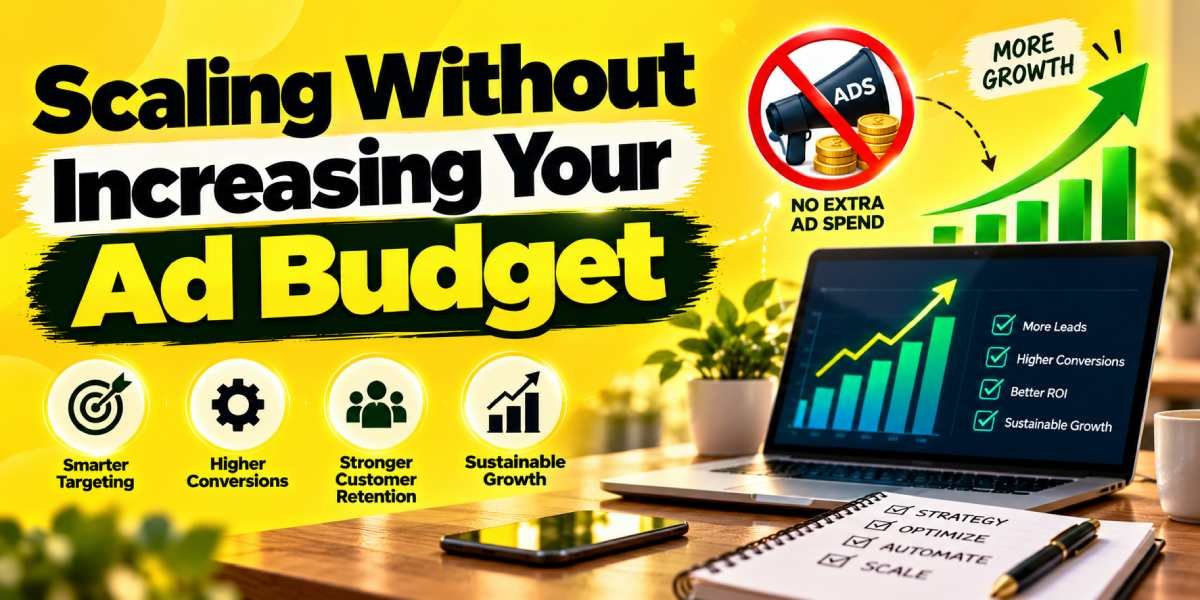
Growing without adding to your advertising budget does not imply that you will come up with some magic trick. It implies making the processes of every stage in your growth engine more effective. Funnel audit, increase in conversion rate, creative refresh, first-party data usage, customer retention, budget reallocation, and offer improvement are just some of the elements of the process, which compound together to give better results on the same budget.
Companies that succeed in scaling do not only invest more money but also create better processes. By creating the right strategy, measurements, creative approach, and customer-driven implementation, growth will become more predictable. Nexotechsoft will assist your business in implementing these principles through professional digital marketing and growth services.