


The Hidden Cost of a Bad Website
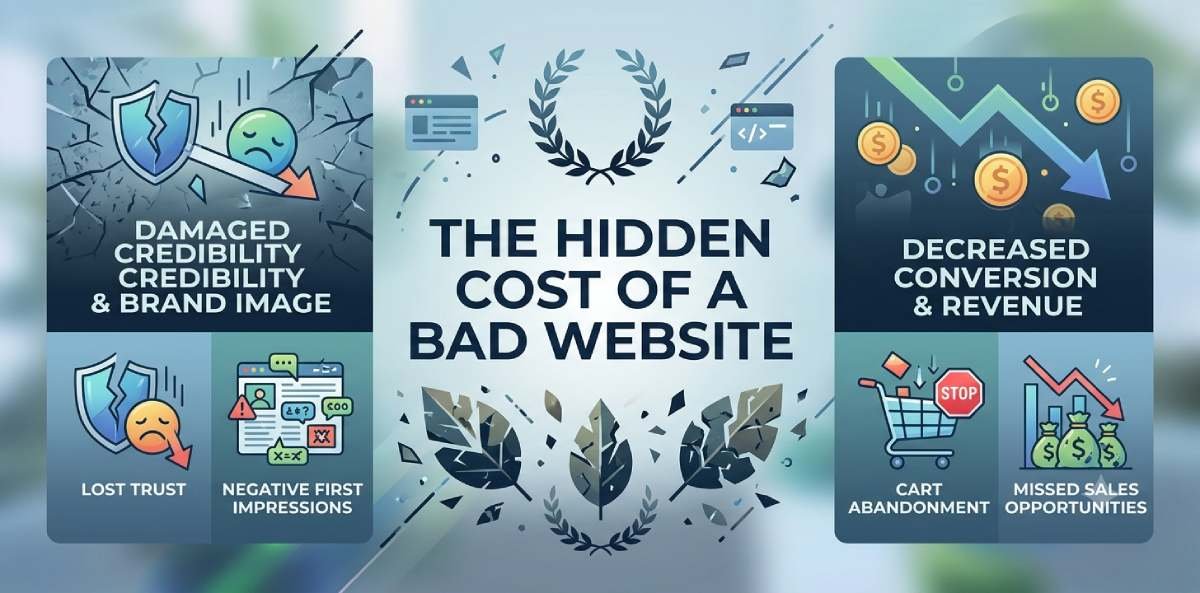
The Hidden Cost of a Bad Website
A website will be the first real contact between you and a client who will visit you. In order to book an appointment, request a quote, visit your physical office, or talk to a sales manager, people usually search online for information first. And they judge your website at once.
In other words, one can state that the website not only serves as an online brochure, but it also becomes a business instrument through which credibility is built, customers’ questions are answered, leads are generated, customer support is provided, and it also contributes to ranking improvement on the web. But, on the other hand, a badly designed and slow website might hurt your business without your knowledge.
The most expensive website is not always the one that has a large price tag. On the contrary, it can be a low-priced or thoughtless website that brings you losses continuously. These losses can come in the form of lost chances, poor search ranking, additional expenses on advertisements, security problems, dissatisfied customers, and constant redevelopments.
Being tech-savvy people today, visitors have very high requirements for websites. They expect websites to be lightning-fast, cross-device functional, secure, and informative. And if your business can’t provide even that minimal set of qualities, you should worry about your reputation.
First Impressions Shape Customer Trust
Online users have a tendency to form their opinions fast. They may not understand every technical detail behind a website, but they can quickly spot an outdated design or poor site organisation.
A too-busy homepage, no consistent brand identity, poor-quality images, broken links, poor readability or a complex navigation system can cause customers to lose their trust in the site. Irrespective of how good the service provided by the website is, it will definitely give off the impression of being a non-professional and detail-oriented company.
This is especially important for companies providing services in spheres like technical services, consulting, digital solutions, finance, health care, SaaS or any kind of professional assistance. In order for people to get in touch with a new company, they should have some guarantee of its reliability and professionalism.
For example, a company offering cybersecurity consulting services with a website having an expired security certificate, broken pages and an outdated contact page would not look very reliable for its potential clients. It becomes obvious that there might be some problems with the service provided.
Professional web development allows building a harmony between the promises of a business and the experience of its visitors.
Slow Loading Pages Lose Potential Customers
The speed of a website is not an insignificant technological aspect. It is directly related to the degree of user engagement, conversions, and satisfaction.
If a webpage loads too slowly, then users may simply abandon it before even viewing its contents and services offered there. This can hurt companies that rely on paid advertising, content marketing, email, and social media because every visitor who leaves represents lost revenue after the company has already invested in attracting them.
There are a lot of different reasons why your website may be loading too slowly. They can include heavy images and inefficient coding, as well as too many plugins and third-party scripts that you do not need. Another possible reason for that is improper settings on the side of your host and ineffective use of caching.
For a visitor, the cause does not matter. They only experience the delay.
A fast website communicates efficiency. It gives users confidence that they can find what they need without friction. A slow site does the opposite. It creates an immediate obstacle at the beginning of the relationship.
Professional programmers consider the performance of software during its planning, design, testing, and maintenance stages. They concentrate on such things as clean coding, optimal assets, responsive designs, efficient architecture, and practical speed enhancements.
Poor Mobile Experience Hurts Growth
Most Internet usage today is generated by mobiles. Individuals perform service searches during travel time, compare products between meetings, shop during TV viewing, and reply to email campaigns using the mobile phone.
If a website does not work well on mobile, it is likely losing opportunities every day.
The mobile issues include small text, difficult tapping buttons, non-functional navigation menus, image problems that disrupt the layout of the site, long forms, and pages that need constant zooming and scrolling. Users need to put effort into using your site when there are such problems.
A responsive web page is not a compressed version of the desktop version of the site. The mobile site needs good design decisions for the user’s convenience. Valuable information needs to be available for the user. Navigation needs to be clear and easy.
Confusing User Experience Reduces Conversions
A website needs to drive its users to do something productive. What this is depends on the individual business, but this can range from scheduling an appointment to asking for a consultation, joining the newsletter, scheduling a demo, placing an order, or just contacting the team.
If visitors are unable to find out more information about the business and what to do next, then the conversions will be poor.
It is not the case that websites have no traffic. The problem lies in the lack of clear information that allows users to understand the following: what does this company do? Who is it for? Why is it better? What needs to be done next?
A bad website forces visitors to search for answers. Your navigation may use vague labels, while generic service pages can leave visitors unsure about what you offer. A complicated contact process can add friction, and buried, repetitive, or unclear calls to action may make it harder for visitors to take the next step.
Effective user experience design reduces that uncertainty. It organises information logically, uses plain language, establishes visual hierarchy, and gives visitors a natural path from discovery to decision.
For instance, a strong professional services website may begin with a clear value proposition, explain key services, show relevant credibility indicators, answer common objections, and offer a simple way to start a conversation. It does not overwhelm the visitor with every possible detail at once.
This is why website design is not just about appearance. It is about helping people complete meaningful tasks with confidence.
Weak SEO Limits Your Visibility
A properly designed website will not be able to expand without attracting customers because of poor visibility on the Internet. SEO is one of the most valuable long-term investments in a professionally built website, yet businesses often overlook it when prioritising speed and cost savings.
SEO requires more than just using keywords. Search engines consider a variety of criteria that relate to technical and user experience factors. Such aspects as site architecture, mobile compatibility, loading speed, secure connection, internal linking, proper headings, indexability of the content, image optimisation and metadata structuring all belong here.
An improperly designed website might contain duplicated pages, faulty links, difficult-to-understand URLs, lack of page titles, broken redirects, inaccessible information, and a poor loading speed. This negatively affects the process of website recognition and ranking by search engines.
The cost is not always obvious. A company might wonder why competitors receive more organic traffic, more enquiries, and more brand visibility. In many cases, those competitors have stronger technical foundations and more structured content.
SEO should be part of the website strategy from the beginning. A professionally developed website is easier to optimise, easier to expand, and more capable of supporting content marketing over the long term.
Security Risks Can Damage Your Reputation
Security is also one of the hidden costs that businesses fail to consider. The website becomes susceptible to attacks when there are old software versions, out-of-date plug-ins, weak passwords, exposed forms, improper integration, or lack of maintenance measures in place.
The following are some of the things that could result from a security breach: website downtime, redirects, spam content, data exposure, poor ranking, and loss of customers’ trust. A disruption can lead to significant losses, particularly when the website handles lead generation or other revenue-generating transactions.
If you have been gathering information from your customers such as enquiries, payments or any other kind of data, it becomes even more important for you. Your visitors expect nothing but good from you in return.
A professional approach to website development involves better security strategies, including proper configurations, updates, access controls, backups, handling of forms and third-party integrations.
Security is not a one-time feature added at launch. It is an ongoing responsibility that should be considered throughout the life of the website.
Cheap Websites Often Require Expensive Rebuilds
For many companies, the low-cost website is the right choice as they are forced to get their site launched fast. It may be a good option for the short term, if the scope is modest and expectations are reasonable. The problem arises when the website fails to evolve along with the business.
New requirements will pop up sooner rather than later. Perhaps the company wants to create pages of services, implement landing pages, integrate a CRM system, implement lead routing, add multilingualism, create a resource centre, incorporate analytics tools or make the website more accessible.
If the site was designed poorly from the start and did not have a structured approach, every step will be harder and harder to achieve. The firm may keep paying for temporary fixes, accumulating technical debt until a complete redesign becomes necessary.
This is where proper planning helps. A good website does not require all the features from the start, yet it must have the proper structure for the future.
Nexotechsoft helps businesses build websites that meet their current needs while supporting future growth. Nexotechsoft offers professional website development, website design, digital strategy, optimisation, and tailored web services. It provides professional services only and does not sell tools or software products.
By working with a professional services provider, businesses can make better decisions about their website architecture, user experience, content structure, performance, and ongoing improvements.
Better Websites Reduce Support Burden
A confusing website creates unnecessary work for both sales and support. Customers will have to call because they are unable to find the necessary information, understand a service, find a policy, fill out a form, or even make a purchase.
This constant barrage of inquiries is usually a symptom of how well the information is being communicated via the website.
A properly designed website can save much effort by providing customers with an opportunity to find necessary information themselves. Good service pages, useful FAQs, clear navigation, easy-to-fill forms, and a transparent process of doing business all help to find answers to basic questions.
This does not substitute for human customer support; it just gives the opportunity to talk about something else.
Conclusion
Not all the costs associated with having a poorly-designed website are visible. Other hidden costs may be loss of credibility, reduced conversions, lack of searchability, wastage of marketing budget, risk of exposure to online security threats, increased demand for customer support services, and redevelopment cost.
In order to have an effective website, a professional web designer must be able to develop a secure, fast, accessible, and user-friendly site that is optimised for search engines.
Nexotechsoft supports this goal through professional website development and digital services tailored to business needs—not through the sale of tools or software products.